Delivery Fleet Management Software for Last-Mile and Courier Operations
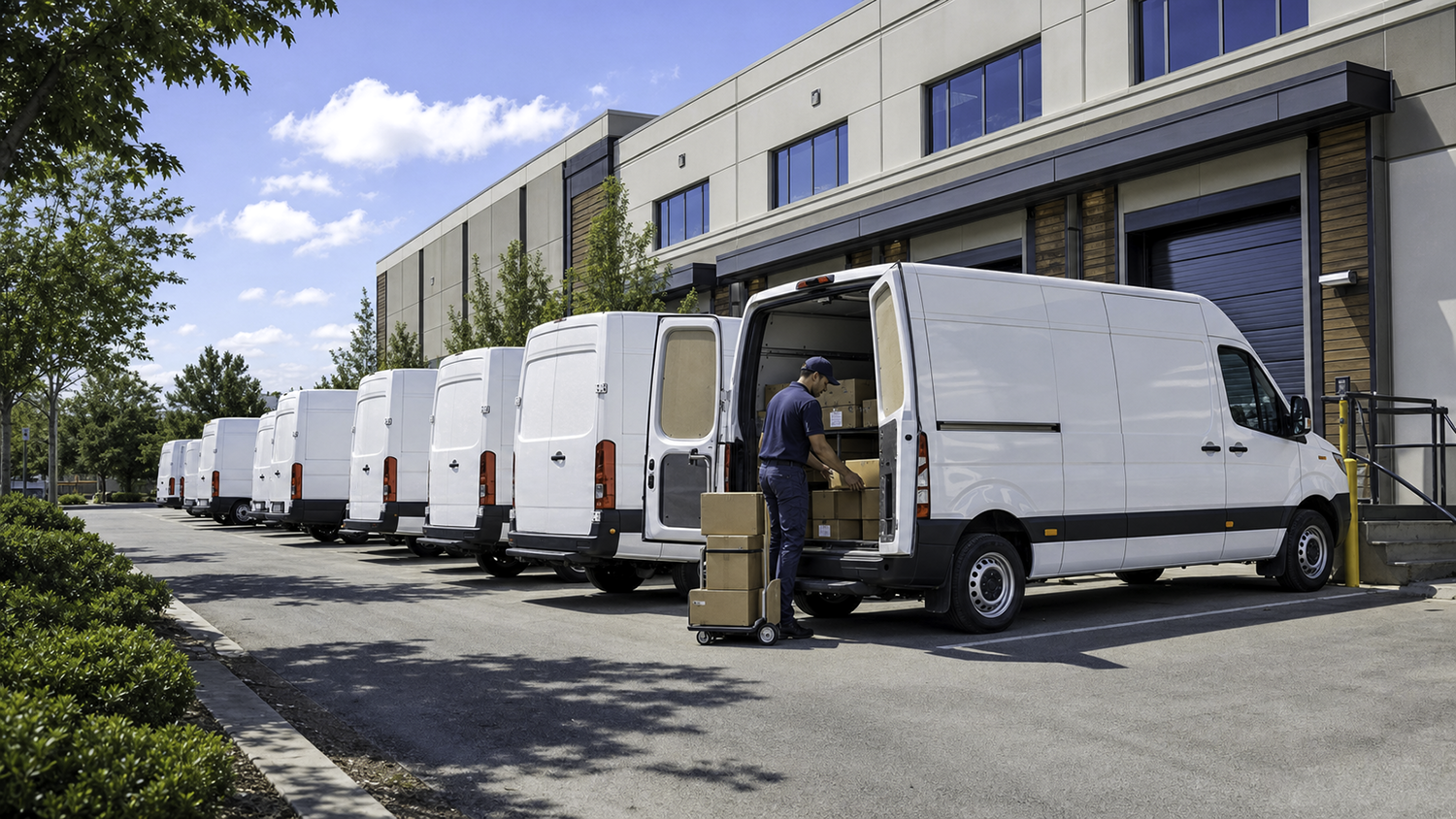
Much of the discussion around GPS tracking and fleet management software for delivery fleets tends to focus on larger operations. You could be forgiven for thinking these tools are only meant for brand-name parcel carriers or enterprise delivery services. But what gets overlooked is that last-mile delivery and local courier services often handle the most important part of these operations: getting packages into the hands of their intended recipients.
While large fleets certainly need GPS-based systems to manage their workflows, last-mile delivery and courier services are under just as much pressure, if not more. They handle high stop counts, tight time windows, and the need to provide proof of service for every package. Delivery fleet management software is a platform that tracks each delivery vehicle's location, trips and stops in real time, then turns that data into records and alerts that dispatchers use to monitor routes, cut idle time and resolve customer disputes.
Those pressures are only more apparent when something goes wrong. Imagine a dispatcher fielding a customer call about a missed delivery. Without location and timestamp data to point to, they have no concrete way to confirm whether a driver was actually on-site. This guide is designed to demystify delivery driver GPS tracking, so operations of any size can address the routing, idle time, proof-of-delivery, and driver accountability problems specific to last-mile work.
The Pain Points of Running a Delivery or Courier Fleet
Before looking at solutions, it helps to clarify the operational problems unique to high-stop-density fleets. The pain points when managing dozens of addresses per driver per day include:
- Inefficient routing that quietly adds unnecessary miles and extra stops per shift.
- Excessive idle time between stops that steadily eats into fuel budgets and driver hours.
- Customer disputes over whether a delivery was actually made, and precisely when it occurred.
- Limited visibility into whether vehicles are being used for unauthorized personal trips after hours or between routes.
- Significant difficulty scaling oversight as the number of drivers and routes grows past what a dispatcher can track manually.
How Real-Time Fleet Tracking Fits Into Delivery Operations
Without real-time data from delivery fleet management software, addressing the problems listed above becomes a guessing game. Live location data fixes that, because dispatchers can reassign stops and reroute drivers whenever a stop is added, canceled, or delayed.
For example, if a courier company is fielding a same-day complaint, they can immediately pull up the exact route and stop timestamps instead of relying on a driver's memory of a busy shift. Continuous tracking, rather than drivers calling in their location, lets dispatchers give customers accurate ETAs.
These are just a couple of ways GPS fleet tracking turns delivery operations from guesswork into active workflow management.
Proof of Delivery and Handling Customer Disputes
The most common friction point for last-mile and courier businesses is proof of delivery, meaning evidence that a stop happened, when it happened, and how long the driver stayed there.
GPS tracking logs a timestamped location history for every trip, showing the exact moments a delivery vehicle arrived at and left each stop. For real-time confirmation, draw a geofence around a customer’s location, and a dispatcher or manager gets a phone or email notification when the vehicle enters and leaves it.
Together, these records give you location evidence for every stop, which protects both the business and the driver when a customer claims no one showed up. They prove the vehicle was there and how long it stayed, but they do not capture a signature or a photo of the package, so many delivery fleets pair tracking with a driver's photo or an electronic proof-of-delivery app for the hand-off itself.
Cutting Idle Time and Fuel Waste on High-Stop Routes
On the cost side, idle time and fuel consumption are two of the largest controllable expenses in delivery and courier operations. Sometimes, drivers may burn excess fuel by taking their lunch break in their work truck, idling with the air conditioning running. However, in a fleet with many stops daily, it’s the small delays that really waste fuel, burning money in the process.
Consider a driver who idles for just a couple of extra minutes per stop while waiting for a customer to come outside or to catch up on paperwork. Two extra minutes at each of 30 stops is an hour of idling every day, or about five hours across a five-day week. Idling burns a quarter to a half gallon of fuel per hour depending on engine size and air conditioner use, according to fueleconomy.gov, so that driver wastes roughly 1.25 to 2.5 gallons every week going nowhere.
Some driving habits also reduce fuel efficiency. Speeding and hard-braking patterns tend to spike when drivers navigate tight delivery schedules, increasing fuel consumption and accelerating maintenance costs.
Without GPS data, these losses show up on the fuel bill but not in any report that explains them. Tracking idle time, speeding and hard braking shows where the waste happens, so you can recover margin without pushing drivers to move faster.
Unauthorized Use and After-Hours Vehicle Oversight
Another major contributor to fuel waste is the unauthorized and after-hours use of fleet vehicles. The fuel you pay for should only be used for company business. Delivery driver GPS tracking can alert you to unauthorized vehicle use so you can address the issue head-on.
A geofence around a driver's assigned service area tells you when a delivery vehicle leaves it during the workday. When something like this happens, an instant notification on your smartphone lets you address it right away and stop the fuel waste.
You can also set up alerts that trigger only when a vehicle moves outside normal business hours, so you know as soon as one leaves the company lot at night. Keeping vehicles where they are supposed to be reduces wear and tear and offers peace of mind.
How to Evaluate Delivery Fleet Management Software
Even though your search for delivery fleet management software will inevitably bring up results for enterprise-class delivery driver GPS tracking solutions, you can find what you need for your last-mile delivery or local courier operation by narrowing your focus.
The broader criteria for choosing a fleet management system still apply, but a delivery fleet should weigh the checks below most heavily.
To make the search easier, just follow these steps:
- Confirm the solution updates vehicle locations continuously. Some lower-priced packages only ping updates every few minutes. Since dispatch decisions must be made based on the current locations of all your fleet vehicles, don’t skimp on real-time tracking.
- Check how easily you can create and edit geofences around individual customer stops. Instant notifications when a vehicle enters or exits a geofence are only useful if the zones keep up with each day's delivery routes.
- Verify how the solution handles trip history. You need enough detail to view each stop on a route, plus easy exports for resolving customer disputes or creating management reports.
- Determine whether you can choose which alerts each person receives and limit some alerts to set hours, so dispatchers are not buried in notification noise during peak hours.
- Confirm the platform scales cleanly as driver and vehicle counts grow, with no hidden costs for essential features.
Avoid these common mistakes when choosing a solution:
- Don't assume one tool does everything. GPS tracking records where vehicles went and how long they stayed, while route-optimization software plans the order of stops, so know which problem you are buying for.
- Never underestimate just how much idle time and small routing inefficiencies cost a business across dozens of daily stops.
- Avoid products that don’t let you easily pull up historical trip data, as this is key to resolving the customer disputes that can pop up days or even weeks later.
- Don't treat delivery fleet management software as a tool you open only when something goes wrong. Reviewed daily, trip history and idle data show which routes run long and which stops eat time, which is where routing and accountability improvements start.
What to Expect From Bouncie for Delivery and Courier Fleets
Some delivery tracking tools are built for large-scale fleets, while others are simple logging devices that can’t help streamline your operations. Bouncie for fleets strikes the right balance as the last-mile delivery tracking solution for operations of any size.
The Bouncie device plugs into the OBD-II port found on most cars, vans and light trucks, standard on US gas vehicles since 1996 and diesel vehicles since 1997. Box trucks with a 9-pin J1939 connector can use an adapter for location, trip history, Geo-Zones and idle time. Bouncie also works with most electric delivery vans, though trip fuel economy, battery status and fuel-related diagnostic codes do not apply to them. Dispatchers then manage the whole fleet from Bouncie's web dashboard at bouncie.app or from the mobile app, with real-time locations for every vehicle.
Bouncie lets you set Geo-Zones around the customer locations your drivers serve and sends an alert when a vehicle arrives or leaves. When you need to reference past stops, Bouncie’s detailed trip history gives dispatchers the reliable record they need to resolve delivery disputes quickly. And rather than forcing you into long-term contracts at predefined tiers, Bouncie offers transparent per-vehicle pricing, billed month to month, making it a truly scalable solution for last-mile delivery and courier services. Measured against the checks above, Bouncie covers real-time location, stop-level Geo-Zones, exportable trip history and after-hours alerts. Route planning and photo proof of delivery come from separate tools.
Delivery Fleet Management Software FAQs
Here are answers to common questions about delivery driver GPS tracking and the available solutions:
Do delivery drivers need to know they're being tracked?
You should tell them. Employers can generally track vehicles they own, but GPS tracking laws by state differ, and some states require employers to notify employees before electronic monitoring. Telling drivers upfront keeps your company on the right side of the law and builds trust with your team.
Does delivery driver GPS tracking slow down dispatch or add extra steps for drivers?
No. A plug-in tracking device reports location and trip data on its own, so drivers have nothing to log or check in. Dispatchers gain real-time visibility, which means fewer check-in calls and faster answers when plans change.
Can GPS tracking prove a delivery was actually made?
It proves the delivery vehicle was at the address, and for how long, through timestamped arrival and departure data. It does not prove the package changed hands, so pair it with a photo of the hand-off for complete proof of delivery.
Is delivery fleet tracking worth it for a small courier business with just a few vehicles?
Yes. Small fleet tracking delivers the same idle-time and dispute-resolution benefits at a smaller scale. Solutions like Bouncie, with per-vehicle pricing, make this powerful technology available to businesses of all sizes.
The Benefits of Tracking for Last-Mile and Courier Delivery
Last-mile delivery and local courier fleets have unique needs that often get overlooked. These operations deal directly with their local communities, which makes route management, proof of delivery, and authorized usage even more important. Nothing short of the company’s reputation is on the line with every stop and delivery.
Although the discussion around GPS tracking platforms often focuses on large businesses and parcel delivery services, any fleet can benefit from tracking as long as it has a solution tailored to its operations. The takeaway is simple. Choose delivery fleet management software that proves every stop, shows where idle time and after-hours use are costing you, and keeps trip history easy to pull when a dispute comes in. Bouncie does all three with a plug-in device and a web dashboard that scale with your fleet. To get started, learn more about Bouncie for fleets.