Teen Driver Curfew: Night Driving Rules and How Parents Hold the Line
Every state and the District of Columbia now has some form of graduated driver licensing, and the strongest programs make a measurable difference. According to the National Highway Traffic Safety Administration, graduated licensing programs that include a nighttime restriction starting no later than 10 p.m., a learner period of at least six months, and a limit of one teen passenger are associated with a 38% reduction in fatal crashes and a 40% reduction in injury crashes among 16-year-old drivers.
While graduated licensing laws typically impose a teen driver curfew, it’s not feasible for police officers to monitor all traffic for young drivers out too late. An officer usually cannot tell a driver’s age or license type at a glance, and in several states the nighttime restriction is a secondary offense, which means police can cite it only after stopping the car for something else. Exceptions for work and school make the rule even harder to police from the roadside.
This reality is why parents still feel some anxiety when their teenager earns an intermediate license. The law sets the standard, but it’s often up to parents to enforce it. This guide explains what a teen driver curfew is, why night driving is riskier for new drivers, where curfews tend to break down, and how to confirm the rule is being kept without constant interrogations or late-night text check-ins.
What Is a Teen Driver Curfew?
A teen driver curfew is the nighttime driving restriction in a state’s graduated driver licensing law. It bars teens who hold an intermediate or provisional license from driving unsupervised during set late-night hours. It is separate from a city or county curfew for minors, which limits when young people can be out in public whether or not they are driving. Laws vary by state, but most use a three-phase structure that looks like this:
- The learner stage: With a learner’s permit, teens can practice basic vehicle handling as long as a fully licensed adult sits in the front passenger seat.
- The intermediate or provisional stage: After passing the road test, the teen receives an intermediate license and can drive alone, but nighttime and passenger restrictions usually apply.
- The unrestricted stage: The nighttime and passenger restrictions end once the teen reaches the state’s set age or has held the intermediate license for the required period.
Each state sets its own hours for its graduated driver license curfew. Start times range from early evening to 1 a.m., and most fall between 10 p.m. and midnight, according to the Insurance Institute for Highway Safety’s graduated licensing laws table. At least one state has no nighttime restriction at all. The restriction lifts either after the teen has held the license for a set period, commonly 6 to 12 months, or at a set age, usually 17 or 18.
What Are the Exceptions to Teen Driver Curfews?
Many states build exceptions into the nighttime restriction. Common ones cover driving directly to or from work, school-sponsored activities, and emergencies, and some states add others, such as religious activities. Driving after hours is also generally allowed when a qualifying licensed adult rides along. The exact list and the adult’s minimum age vary, so check your state’s driver licensing agency before you set household rules.
Why Night Driving Is Riskier for New Drivers
Because parents do most of the enforcing, it helps to know why states put the nighttime restriction in place.
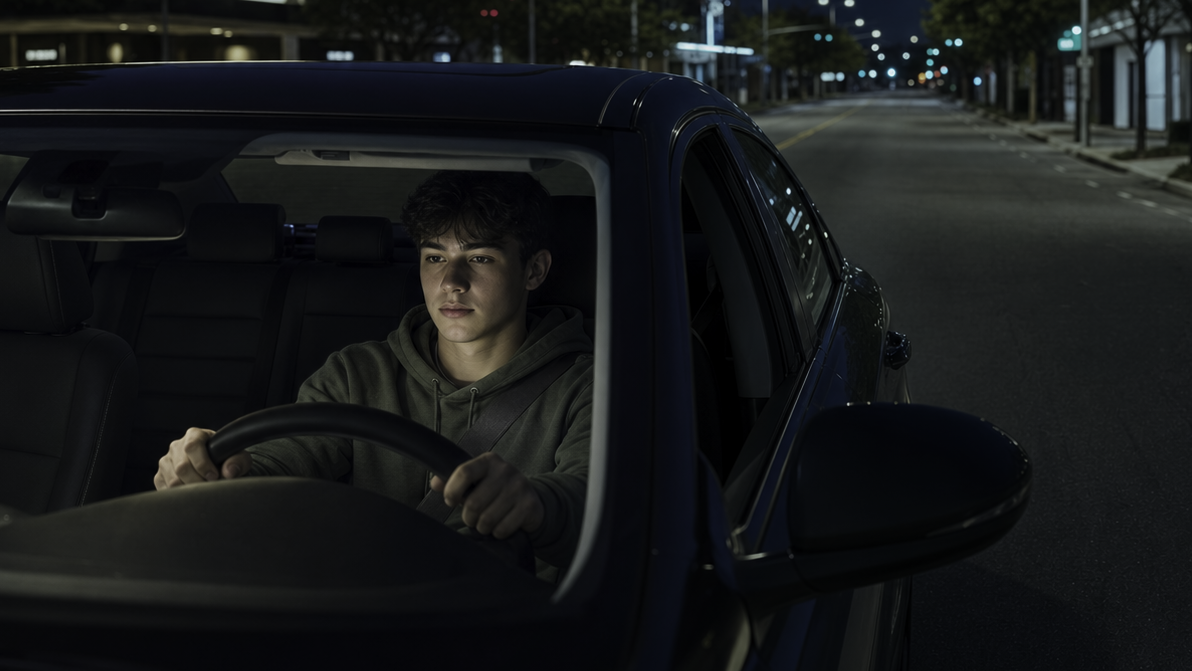
The main reason is that night is when new drivers are most exposed. According to the Children’s Hospital of Philadelphia (CHOP) Teen Driver Source, the fatal crash rate at night for drivers ages 16 to 19 is about three times that of adult drivers per mile driven, and most fatal nighttime crashes involving teens happen between 9 p.m. and midnight.
A few biological and environmental factors combine to create this increased risk:
- Limited visual range: Darkness reduces contrast and hides the peripheral cues drivers rely on in daylight. AAA testing found that halogen headlights may fail to safely light unlit roads at speeds as low as 40 mph, which leaves less time to spot road hazards, stopped traffic, or pedestrians.
- Lack of experience assessing hazards: Newer drivers haven’t yet logged the thousands of hours it takes to read sudden hazards quickly. In darkness, judging distance and speed becomes even harder.
- Fatigue: After a long day of school, sports, and a part-time job, most teens run low on energy. Nighttime fatigue slows their reaction time and reduces their concentration behind the wheel.
- A more dangerous roadway: Other drivers on the road after dark are more likely to be impaired or drowsy. A teen driver hasn’t yet developed the defensive skills to navigate another vehicle's unpredictable behavior.
Passengers add to teen driving risks by pulling a new driver’s attention away from the road. A AAA Foundation for Traffic Safety study found that, compared with driving alone, a 16- or 17-year-old driver’s risk of death per mile driven rises 44% with one passenger under 21 and doubles with two. That is why most states also limit passengers during the intermediate stage. Put together, the riskiest trip for a new driver is a late-night drive with friends in the car, which is exactly the trip a curfew and a passenger limit are designed to prevent.
Where Curfews Break Down in Real Life
Enforcing a teen driving curfew is not as straightforward as it sounds. The problem usually isn’t that teens are defiant rule-breakers. Instead, real-life concerns like jobs and school events mean you have to make regular judgment calls on curfew exceptions.
That doesn't mean teens won’t turn exceptions into loopholes. For example, if your teen’s evening shift at a local restaurant ends at 10:30 p.m., state law may allow them to drive directly home afterward. But instead of heading home right away, they linger in the parking lot talking, or they follow coworkers down the street for fast food. Before you know it, the teen’s car pulls into the driveway 15 minutes after midnight.
On paper, the trip looks like a work exception. In practice, work exceptions usually cover driving directly to or from the job, so the detour for food likely fell outside it, and it kept the teen on the road during the hours when fatal night crashes peak.
When a teen is “just dropping a friend off,” curfews further erode. They may leave a school athletic event before the legal deadline, but agreeing to drive two teammates home adds stops, extra miles, and peer distraction to the trip. What was intended as a routine trip home becomes late-night driving with two teen passengers, which stacks the two risks a graduated license is built to limit.
The Problem With Location Apps
Many parents try to close these gaps with a phone location-sharing app. It is a reasonable first step, but phone apps have a few weaknesses when the question is where the car went. Smartphones routinely run out of battery power or lose cellular reception and then stop broadcasting location data. Low-power mode can limit location updates, and the app may lose permission to use the phone’s location.
A teen can even leave their phone at a friend’s house when they hop in their car, completely defeating the location app as a tracking tool. When parents lack objective data about where their teen’s car is and has been, the exceptions and loopholes to curfew laws become the norm.
For curfew questions, a GPS tracker in the vehicle answers what the phone cannot, because it reports on the car itself. The tradeoff runs the other way too. A vehicle tracker sees only the car it is plugged into, so if your teen rides in a friend’s car, a phone app is the tool that follows them.
Trackers that plug into, and draw power from, the standard OBD-II diagnostic port report the vehicle’s location whenever the engine is on. They read diagnostic data from the car’s onboard computer, track speed, and use built-in sensors to flag hard braking and rapid acceleration. Timestamped trip logs then show exactly when the car left and when it came home.
How to Hold the Line on Your Teen's Driving Curfew
A curfew holds when the rules are clear, the exceptions are agreed in advance, and you have a reliable way to confirm what happened. An OBD-II GPS tracker handles the confirming, and the plan below covers the rest. It works during the graduated license period and can carry on as household rules after the legal restriction lifts. No more helicopter parenting, interrogating friends for details, or sleepless nights. Here’s a step-by-step action plan:
- Verify the laws in your state: Find your state’s motor vehicle agency and confirm the curfew hours and any exceptions that apply to your teen’s license.
- Establish household rules: State law sets the baseline, but your household rules need to fit your family’s real schedule, because teens can only follow rules that are realistic.
- Formalize the exceptions: Work shifts and school activities are common legal exceptions, but any other exception should be agreed in advance and fit your household rules.
- Set up curfew and arrival alerts: Using the GPS tracker’s geofencing features, you can receive notifications on your phone when your teen arrives at or leaves specific areas (home, work, school, etc.). Many trackers also offer curfew alerts that notify you if the car is driven during hours it should be parked.
- Review violations the next day: Curfews are often violated late at night when everyone’s tired, which isn't a good time for a rational discussion. Use the tracker’s trip history the next day to review departure times, routes, and driving behavior using objective GPS data.
- Implement tiered consequences: Define multiple levels of consequences so the punishment for being 15 minutes late isn't the same as for coming home at 3 a.m.
To put your household rules and exceptions in writing, see our guide to creating a teen driving contract.
When Should I Allow Exceptions to the Curfew?
Realistically, you can’t enforce a teen driver curfew without making regular exceptions for school or life events. The trick is keeping those exceptions from turning into recurring loopholes.
Here’s guidance on how to find the right balance:
- When to permit an exception: Exceptions permitted by law, such as driving home from work or from school functions, are OK. Otherwise, allow exceptions only if you schedule them in advance with verified departure and arrival times.
- When to tighten privileges: Roll back unsupervised driving hours if your teen repeatedly fails to communicate the reason for delays. Any driving citations, such as a speeding ticket, are also a good reason to rein in privileges. If speeding is the pattern, see our guide to devices to prevent teen speeding.
- When to expand curfew hours: As your teen gets closer to legally unrestricted driving, and if they’ve maintained a clean driving record, gradually extend their evening driving hours. Adulthood will eventually grant them unrestricted driving privileges, so it’s important to let them gain some independence gradually rather than all at once.
Mistakes That Undermine Accountability
Most parents find that enforcing a teen driving curfew takes some trial and error. To get things right, avoid these mistakes that take the focus off of driver accountability:
- Setting rules with no way to verify compliance: Announcing a curfew without a way to confirm vehicle arrival times makes it feel less like a rule and more like a suggestion.
- Relying on phone tracking alone: A phone can be left behind, powered off, or lose signal, so it cannot confirm when the car itself was driven.
- Concealing vehicle monitoring: Secretly installing a GPS tracker or other monitoring device can feel like surveillance rather than a safety tool.
- Treating all violations the same: A teen who communicated an unexpected delay shouldn’t face the same consequences as one who snuck out to drive past curfew.
- Assuming the laws are the same everywhere: Curfews vary by jurisdiction, so make sure you know the rules your teen should follow.
How Bouncie Helps Parents Keep Curfew Honest
You likely don’t have the time or inclination to hover over your teen and micromanage their schedule. But if you aren’t actively enforcing the rules, exceptions become the norm, and then there’s effectively no curfew. To keep curfew enforcement honest, you need automated, objective data, and that’s what Bouncie provides.
The Bouncie device plugs into the OBD-II port in your teen’s car and reports where and when the car was driven, both in real time and through a detailed trip history. It is not a surveillance tool or a way to block trips, lock the car, or restrict driving privileges.
The Geo-Zones feature lets you define geofenced locations, so you receive notifications when your teen’s car enters or exits those areas. With Curfew Alerts, you choose the hours the car should stay parked, and the Bouncie app notifies you if it is driven during that window.
The Bouncie teen driving app reports on the car, not the people in it, so it will not tell you whether passengers are on board. Your passenger rules still depend on clear expectations and conversation. As a tool for families, Bouncie provides objective data to help everyone stay honest when enforcing (and sticking to) a teen driver curfew.
Teen Driver Curfew FAQ
What time does a teen driver curfew start?
It depends on the state. Start times range from early evening to 1 a.m., and most fall between 10 p.m. and midnight. Check your state’s driver licensing agency for the exact hours.
Can my teen drive after curfew to get home from work?
In many states, yes, as long as the trip goes directly to or from work. Stops along the way usually fall outside the exception. Confirm the rules in your state, because the list of exceptions varies.
Does the curfew apply if a parent is in the car?
Generally no. Most states allow nighttime driving when a qualifying licensed adult rides along, though the adult’s minimum age varies by state.
What happens if my teen breaks curfew?
Penalties are set by each state, so check your state’s driver licensing agency for the specifics. At home, a calm next-day review of trip history and consequences that fit the violation tend to work better than a late-night argument.
Will a GPS tracker stop my teen from driving after curfew?
No. The Bouncie device reports where and when the car is driven. It does not block trips, lock the car, or disable the engine. With Curfew Alerts, you choose the hours the car should stay parked and get a notification if it moves.
Holding the Line for Safety
Graduated driver license laws don’t impose curfews as an arbitrary punishment or an inconvenience. These restrictions are meant to keep teens safe as they transition into adulthood and full driving freedom. Police can only do so much, so the job falls mostly to parents. The plan is simple. Know your state’s hours and exceptions, agree on household rules in advance, use automated alerts and trip history to confirm what happened, and respond with consequences that fit the violation.
When your schedule gets packed, it’s easy to allow curfew exceptions to become standard loopholes. Bouncie is a silent partner in helping you hold the line for safety. To get started, see how Bouncie’s GPS trackers for teens help you hold the line on curfew.