4G LTE vs 5G GPS Trackers: Why LTE Is the Better Choice

From time to time, someone researching GPS trackers will ask:
“What about 5G?”
It is a fair question, and the answer comes down to how 4G LTE and 5G actually compare for a GPS tracker. In the marketing for consumer electronics and mobile devices, 5G has been positioned as the modern standard for connectivity. This follows years of consumers hearing that newer and faster are always better, regardless of the use case. But when it comes to purpose-built hardware, that can be an incorrect and expensive assumption.
The short answer is that 4G LTE is the better choice for a GPS tracker because it delivers the same tracking performance as 5G with wider coverage and a lower cost. What makes a network great for streaming video on your phone is different from what makes a network great for a telematics device transmitting real-time vehicle data. Bouncie continues to use 4G LTE networks because they are the most reliable and cost-effective way to deliver the best GPS tracker on the market.
Smartphones and Telematics Devices Have Different Requirements
That’s not to say that 5G isn’t amazing technology. If you remember the first time your smartphone connected to a 5G network, you probably recall that it felt faster than ever. All of a sudden, 4K videos were streaming in full quality, and web pages were loading instantly. So, why wouldn’t we want that kind of speed for our devices?
The first thing to understand is that devices across different categories have different requirements. When you use your phone, you might be streaming that 4K movie while downloading a 10-gigabyte software update and uploading your latest batch of high-resolution photos to the cloud. These operations require a lot of bandwidth to run smoothly. The multi-gigabit speeds promised by 5G networks are a godsend for modern smartphones, tablets, and laptops with cellular connectivity.
A telematics device, on the other hand, has much more modest requirements. When your vehicle is in motion, it simply listens to its internal computer and the GPS satellite network, then transmits small data packets to servers. These packets include:
- GPS coordinates
- Vehicle speed and heading
- Accelerometer events
- Diagnostic trouble codes (the Check Engine light or other informational messages)
- Battery voltage levels
- Fuel levels and odometer updates
All of this data is important, but its footprint is minuscule compared to what goes in and out of your smartphone. A typical update from a telematics device is measured in a few hundred bytes, which is why a GPS tracker does not need the bandwidth that a phone does. Even if you drive for hours, a full day of continuous telematics data transmission is often smaller in file size than loading just one ad-heavy webpage on your phone.
The Numbers Behind 4G LTE vs 5G Bandwidth for GPS Tracking
In fact, the bandwidth requirements for a telematics device are so minimal that not only is 5G's bandwidth overkill, so is that of 4G LTE.
According to Opensignal's 2025 Mobile Network Experience report, 4G LTE networks in the US offer download speeds ranging from 18 Mbps to 100+ Mbps, depending on the carrier. Meanwhile, average upload speeds are anywhere from 5 Mbps to 15 Mbps. Latency, which is the time it takes for data to travel from a device to a server, ranges from 30 to 50 milliseconds, according to networking benchmarks.
Now, let's look at the data a typicla telematics devices sends. A location update payload is just a few hundred bytes. Even if it’s set to transmit updates every second, it’s only using a microscopic fraction of a 1 Mbps connection. You could theoretically run thousands of Bouncie devices simultaneously on a single standard 4G LTE connection without ever saturating the upload bandwidth.
Some tech enthusiasts might argue that 5G's super-low latency makes for better real-time tracking. In practice it does not, because reducing latency by 15 or 20 milliseconds does not change the end-user experience in your mobile app. Not only is this an imperceptible difference, but the speed of Apple's or Google's push notification delivery networks (which are very fast) contributes more delay in your receiving a notification than LTE’s upload speeds.
For a GPS Tracker, Reliability Matters More Than Speed
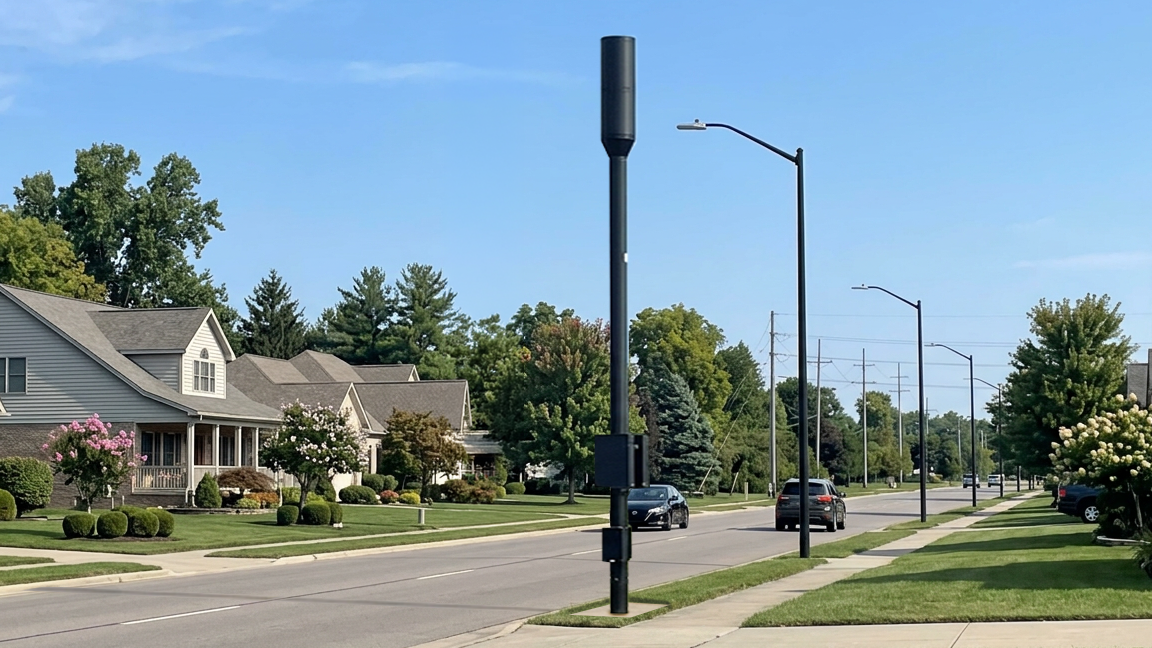
Considering that telematics devices have much lower bandwidth requirements, the real issue is not cellular network speed but reliability. A GPS tracker that loses signal and goes silent when you drive into rural areas or down a remote stretch of interstate is fundamentally a brick. It doesn't matter if your tracker can theoretically upload data at 500 Mbps if it has no service.
4G LTE networks have been in use for well over a decade now, and they’ve been highly optimized in that time. They offer coverage through dense forests, long desert highways, and the sprawling rural routes of middle America. These networks are proven, consistent, and resilient.
This reliability gap is where 4G LTE pulls ahead. While 5G networks are growing rapidly, they still work best in densely populated urban and suburban areas that have received significant infrastructure investments. High-frequency 5G signals do not travel far and struggle to penetrate buildings or tree cover. If you drive outside those areas, 5G coverage drops off quickly, and devices are forced to rely on lower-band frequencies or simply fall back to LTE anyway!
The Cost of Upgrading: Paying More for No Noticeable Improvements
But you may ask why not just upgrade the hardware to 5G, since it's theoretically faster and backward-compatible with LTE? The answer is one of simple economics. Switching to 5G hardware would increase the retail price significantly while offering no improvement in tracking performance.
Here is why 5G hardware, at least for now, is so expensive:
- Component costs: 5G cellular modems have significantly higher wholesale costs than 4G LTE ones. The chips are newer, and the licensing fees remain high. The modems also require additional radio frequency (RF) components and more sophisticated antenna arrays to handle the multiple frequency bands used by 5G.
- Regulatory overhead: The certification process for a 5G device through regulatory bodies such as the FCC and carrier networks is more rigorous, time-consuming, and expensive.
- Power draw and heat: 5G modems consume more power, which means generating more heat. Therefore, they require better thermal management within the small plastic housing. Plus, for an OBD-II tracking device like Bouncie, the higher standby power draw puts an unnecessary strain on your parked vehicle's 12-volt battery.
The takeaway is simple. Building a 5G telematics device today, you would be paying a premium for a device that delivers identical tracking data, update frequencies, and coverage footprints to the LTE version.
LTE Isn’t Going Anywhere (For Good Reason)
A common concern we hear from fleet managers and individual buyers is about 4G LTE’s longevity. You may remember the headaches when carriers shut down 2G and 3G networks, rendering some devices, including older GPS trackers and alarm systems, obsolete. It’s only logical to wonder if 4G LTE is next on the chopping block.
The good news is that LTE is not going anywhere. If you look back at when 2G and 3G were retired, LTE was deployed specifically to future-proof mobile data. After all, LTE stands for Long-Term Evolution, and it’s meant to be the foundation of cellular infrastructure for years to come, evolving as standards change.
In fact, the vast majority of 5G deployments right now are non-standalone (NSA) networks, which run on top of existing LTE infrastructure. The two technologies are intrinsically linked. Industry experts at Digi International confirm that 4G LTE will co-exist with 5G well into the 2030s because the infrastructure is so intertwined.
And there is another good reason LTE is not going anywhere. Billions of IoT (Internet of Things) and smart devices, such as utility grid meters, medical monitoring equipment, retail payment terminals, and home security systems, all depend on LTE networks. Cellular carriers aren’t going to sunset LTE simply because it would be catastrophic to global infrastructure.

What About the Automotive Industry’s Hype Over 5G Connectivity?
So, if 4G LTE is the better choice for vehicle telematics, why has the automotive industry spent years positioning 5G as the next great leap forward?
It’s true that automakers like Ford, General Motors, and Tesla have heavily invested in connected car features that leverage 5G connectivity. These are data-heavy technologies that can take advantage of 5G’s bandwidth and low latency, such as:
- Autonomous driving systems: Self-driving cars require real-time communication, potentially processing gigabytes of environmental data in milliseconds to prevent collisions.
- Ultra HD content and infotainment: Automakers can utilize 5G's bandwidth for speedy 4K video streaming and advanced in-cabin infotainment systems
- Complex OTA updates: Modern electric vehicles that routinely download multi-gigabyte over-the-air (OTA) software updates to patch infotainment and drivetrain software benefit from 5G download speeds.
- Passenger Wi-Fi: Many modern vehicles have Wi-Fi hotspot features. For families on road trips, 5G’s higher bandwidth ensures everyone enjoys speedy connectivity.
Keep in mind, however, that the automakers aren’t talking about transmitting a vehicle's GPS coordinates or battery voltage over 5G. They know that vehicle telematics data doesn’t require that kind of bandwidth.
Bouncie: Built for Reliability and User Experience, Not Headlines
Bouncie is all about efficiency and reliability, and its 4G LTE connectivity is a part of that. Small data packets, guaranteed delivery, and nationwide coverage for years to come are exactly what the LTE network was built for, and that's why it's perfect for Bouncie.
Because Bouncie is backed by a stable, reliable network, we can focus our resources on a better user experience. We put extra work into the Bouncie app because that’s what you actually use every day. The app gives you real-time location mapping, detailed trip histories, and driver-behavior alerts without any compromises in speed.
By sticking with tried-and-true LTE, Bouncie doesn't ask you to pay for performance overhead you will never use. Our network platform is stable and designed to carry your vehicle's data safely throughout the device's expected lifespan.
FAQs About Vehicle Telematics, 4G LTE, and 5G
Here are quick answers to common questions about vehicle telematics devices and network connectivity:
Does Bouncie use 5G?
No. Bouncie uses 4G LTE cellular connectivity. This allows us to provide maximum nationwide coverage, high reliability, and an affordable price point without charging customers for unused bandwidth capacity.
When will Bouncie upgrade to 5G?
There are currently no plans to switch Bouncie to 5G modems while 4G LTE remains the most cost-effective solution for telematics data. We will transition to new network technologies only when they offer a tangible benefit to the user experience.
Would a 5G Bouncie device actually track my vehicle any better?
No. Because GPS tracking relies on sending very small amounts of data (a few hundred bytes per update), 5G's massive data speeds would not make your vehicle's location updates any faster or more accurate in your app.
Will my Bouncie device stop working when 5G becomes the standard?
No. 5G networks are largely built on top of existing 4G LTE infrastructure (known as non-standalone architecture). Because billions of critical infrastructure devices rely on LTE, the network will remain active and fully supported well into the future.
Is 4G LTE fast enough for real-time GPS tracking?
Yes, it is more than fast enough. A Bouncie device uses a fraction of a megabit to transmit its data. With 4G LTE offering speeds that easily exceed 15-20 Mbps upload in most areas, the network is incredibly fast and capable for real-time location streaming.
Why do some GPS trackers advertise 5G if it doesn't improve tracking?
Mostly for marketing. Some manufacturers treat 5G as a selling point, and others use 5G compatibility to justify a higher price, even though it does not improve tracking accuracy or speed.
Why 4G LTE Is the Right GPS Tracker Choice
The best technology solves problems reliably. Too often, headlines with dazzling numbers gain more attention, but it’s important to dig deeper. In the world of connected vehicles, data size is small, but the need for geographic reliability is massive.
4G LTE is not a compromise or a limitation for vehicle telematics. Upgrading an OBD tracker to 5G today would cost customers nearly 50% more on hardware, yield no functional improvements in app performance, and offer no better coverage. This is why Bouncie offers the best mix of functionality and reliability. Learn more about the Bouncie OBD-II GPS tracker today.